
AI & Automation
AI Chatbots for Business: Use Cases, Benefits and Setup
A business AI chatbot answers from information you approve, collects useful enquiry details and passes the conversation to a person when it should stop. Done well, it reduces repetitive questions and improves response consistency. Done poorly, it invents answers, traps customers in loops or creates noisy leads.
What Is a Business AI Chatbot?
A business AI chatbot is a conversational interface connected to approved information about your offer, policies and processes. Its job is to help visitors or customers get accurate answers quickly, gather context for your team and escalate cleanly.
It is not a replacement for judgement on edge cases, complaints or negotiations. It is also not automatically an agent with deep tool access — unless you intentionally build that capability.
How AI Chatbots Work
Most business chatbots combine retrieval over your approved content with a language model that drafts a reply. The quality ceiling is usually your knowledge base and your refusal rules — not marketing claims about “human-like” tone.
- Visitor asks a question in chat.
- The system retrieves relevant approved content.
- The model drafts an answer within policy.
- If needed, the bot asks clarifying questions or offers handoff.
- Transcript and lead fields are stored for your team.
Practical AI Chatbot Use Cases
- Website FAQs about services, delivery, hours and eligibility.
- Pre-sales questions that prepare a quote conversation.
- Customer service triage for common account or order issues.
- After-hours collection of enquiry details for next-day follow-up.
How Chatbots Capture and Qualify Leads
When the chatbot does not know the answer, it should say so, avoid guessing and offer a human follow-up. Inventing a confident wrong answer is worse than a short refusal.
Website Chatbots vs Messaging Integrations
Website chat is usually the simplest first surface because you control the page and the brand experience. Messaging apps can meet customers where they already write, but they add platform rules, template constraints and support expectations that must be designed deliberately.
How to Prepare Your Business Information
- List the top questions your team already answers repeatedly.
- Point each answer to an approved page or document owner.
- Write refusal language for legal, medical, pricing and out-of-scope topics.
- Define lead fields sales actually uses.
- Decide business-hours vs after-hours behaviour.
Human Handoff, Accuracy and Privacy
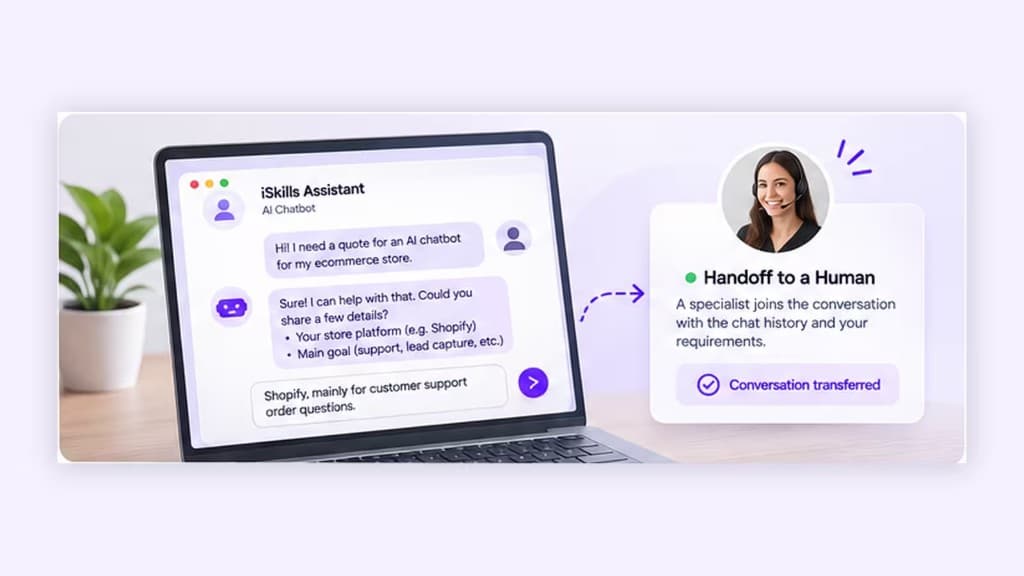
Handoff should include the transcript, the visitor’s goal and any captured fields. Accuracy improves when the bot is not forced to answer everything. Privacy improves when you collect only what you need and store it in systems your team already governs.
How to Set Up an AI Chatbot for Your Business
- Choose one primary surface (usually the website).
- Approve the knowledge set and refusal rules.
- Configure lead fields and destination (CRM, inbox or form).
- Test common questions, hostile questions and “I don’t know” paths.
- Review transcripts weekly for the first month.
iSkills AI Chatbots work is scoped around approved content, enquiry capture and clear handoff — not open-ended promises about every messaging network.
Common Implementation Mistakes
- Letting the bot invent answers outside the knowledge base.
- Collecting lead fields nobody will follow up.
- Skipping after-hours behaviour design.
- Launching on five channels before one path is reliable.
- Never reviewing transcripts.
Key Takeaways
A useful business chatbot is a controlled conversation system with approved answers, disciplined lead capture and honest escalation. If you later need tool-using task automation across systems, read What Are AI Agents? and compare options in AI Agents vs Chatbots.
Frequently Asked Questions
Will a chatbot work on WhatsApp or Instagram automatically?
Not by default. Messaging channels need their own setup, approvals and handoff rules. A website chatbot and a messaging chatbot are related projects, not free extras.
Can the chatbot take payments or give legal advice?
Only if you deliberately design, approve and monitor those flows — and even then many businesses keep regulated or high-risk answers with humans. Do not imply the bot can advise beyond published policy.
How do we stop invented answers?
Limit the knowledge base, require citations to approved content where possible, and force a handoff or honest refusal when confidence is low or the topic is out of scope.
What should we measure?
Deflection of repetitive questions, qualified enquiry rate, handoff quality and unresolved-conversation rate. Avoid vanity metrics such as raw chat volume alone.
Ready to talk this through?
Discuss whether this approach fits your systems, permissions and team capacity.
Plan Your Business AI Chatbot