
AI & Automation
AI Agents vs AI Chatbots: Which Does Your Business Need?
If you need reliable answers and enquiry capture on your website, start with a chatbot. If you need software that prepares or performs work across business tools under clear limits, look at an agent. Many modern products blur the line — the decision should follow the job to be done, not the buzzword.
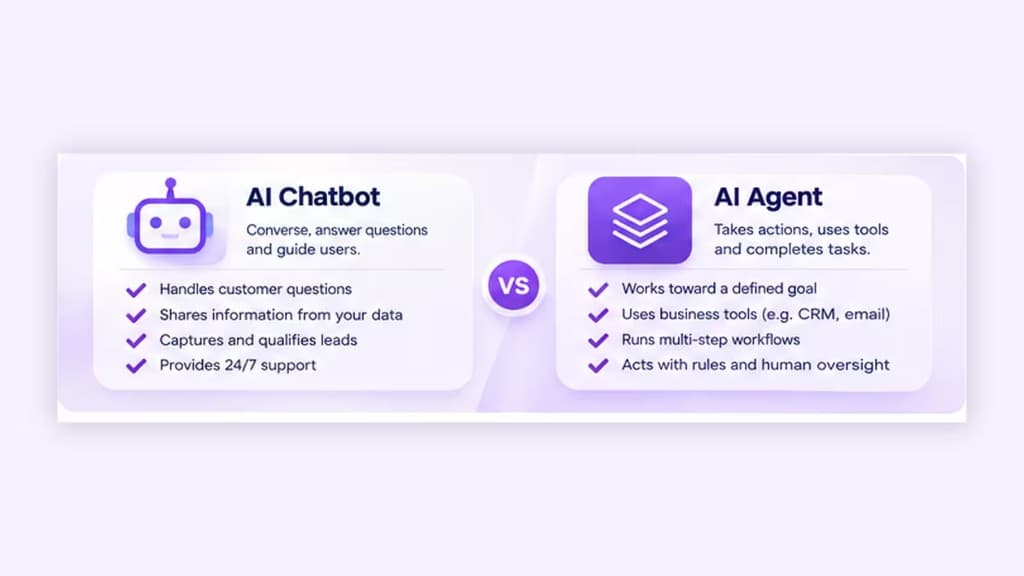
AI Agents vs AI Chatbots: The Short Answer
Use a chatbot when the primary job is conversation: answers, guidance and lead capture. Use an agent when the primary job is completing or preparing work in systems: CRM updates, document handling, scheduling support or multi-step operations with logging.
What Does an AI Chatbot Do?
A chatbot converses. It retrieves approved information, asks clarifying questions, captures contact details and escalates to a person. Its success metrics are answer quality, containment of repetitive questions and useful enquiry handoff. Details: AI Chatbots for Business.
What Does an AI Agent Do?
An agent pursues a goal with tools. It may read and write records, draft communications, call APIs and pause for approval. Its success metrics are completed workflows, exception rates and auditability. Details: What Are AI Agents?.
Key Differences at a Glance
| Dimension | AI chatbot | AI agent |
|---|---|---|
| Primary function | Conversation and guidance | Task preparation or execution |
| Customer interaction | Usually front-stage chat | Often back-office or mixed |
| Tool access | Limited or none by default | Central to the design |
| Task execution | Mostly answers and forms | Updates, routing, drafting across systems |
| Predictability | Higher when knowledge is tight | Depends on tools and approvals |
| Setup complexity | Usually lower for website FAQ bots | Usually higher due to integrations |
| Human oversight | Handoff and transcript review | Approvals, logs and exception queues |
| Maintenance | Knowledge and refusal updates | Tools, permissions and failure handling |
| Suitable use cases | FAQs, lead capture, triage | CRM ops, document prep, multi-step workflows |
Real Business Scenarios
When a Chatbot Is the Better Choice
- Most pain is repetitive questions on the website.
- You can approve a finite knowledge set quickly.
- You need lead capture more than system write access.
- Your team is not ready to manage tool permissions yet.
When an AI Agent Is the Better Choice
- Work spans multiple systems after the conversation ends.
- People spend time interpreting requests and then clicking the same tools.
- You can define permissions and approvals clearly.
- You can monitor logs and exceptions.
When You Might Need Both
A common pattern is chatbot front-stage, automation or agent back-stage. The chatbot qualifies and explains. The downstream system prepares the work. That split keeps customer conversation simpler while still reducing admin load.
Cost, Complexity and Maintenance Considerations
Chatbots typically require ongoing knowledge maintenance. Agents typically require ongoing integration and permission maintenance. Neither is “set and forget.” Avoid vendor pricing comparisons that ignore your systems landscape.
How to Choose the Right Approach
- Write the job to be done in one sentence.
- List systems touched after a successful enquiry.
- Mark which steps need conversation vs tool action.
- Decide the blast radius of mistakes.
- Pilot the smaller surface that still creates value.
Explore AI Chatbots and AI Agents as separate service paths with scoped proposals — not as interchangeable labels.
Final Recommendation
Choose the system that matches the work. If conversation is the bottleneck, start with a chatbot. If cross-tool execution is the bottleneck, design an agent or automation workflow with limits. If both exist, sequence them — do not force one product to pretend it is the other.
Frequently Asked Questions
Can a chatbot become an agent later?
Sometimes. If your platform supports controlled tool use and you add permissions carefully, a conversational assistant can grow into limited agent behaviour. Treat that as a new design phase, not a toggle.
Which is cheaper?
There is no honest universal answer. Chatbots often cost less to start because the surface area is smaller. Agents usually need more integration and oversight design. Ask for a scoped proposal, not a generic benchmark.
Which is safer?
Safety depends on permissions and review. A chatbot with weak refusal rules can still mislead customers. An agent with write access and no approvals can change records incorrectly. Design the blast radius deliberately.
Should SMBs skip agents?
Not automatically. A small team with a repetitive cross-tool workflow may benefit from a narrow agent pilot. A small team with FAQ overload may get more value from a chatbot first.
Ready to talk this through?
Discuss whether this approach fits your systems, permissions and team capacity.
Find the Right AI Solution for Your Business