
AI & Automation
What Are AI Agents? How They Work for Businesses
An AI agent is software that can take a business request, use approved tools or systems, and carry out or prepare actions within limits you define. It is not magic automation and it is not a guarantee of correct decisions. Useful agents depend on clear permissions, reliable integrations and human oversight where mistakes would be expensive.
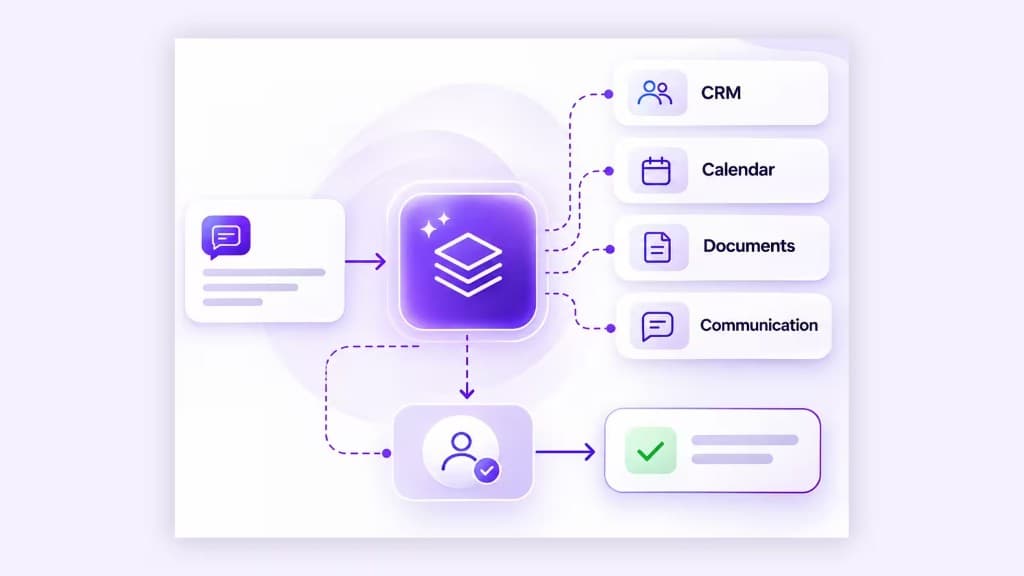
What Is an AI Agent?
In business settings, an AI agent is a system that receives a goal or request, uses available context, and then works through permitted tools to produce an outcome. That outcome might be a drafted reply, an updated CRM record, a scheduled follow-up or a package of information for a person to approve.
The important difference from a simple Q&A assistant is task orientation. Answering “What are your opening hours?” is retrieval. Preparing a qualified lead record, checking calendar availability and drafting an outreach message is agent-style work — still bounded by whatever permissions you grant.
How Do AI Agents Work?
- Receive a request from a person, form, inbox or another system.
- Gather relevant context from approved sources such as CRM fields, FAQs or recent tickets.
- Select permitted tools — for example search, calendar, CRM update or document lookup.
- Execute or prepare actions according to business rules.
- Log what happened and escalate when confidence is low or a rule requires a person.
Vendors describe this loop differently, but the operational questions stay the same: What can the agent read? What can it write? When must a person decide? How do you audit mistakes?
Practical AI Agent Examples for Businesses
The scenarios below are illustrative patterns, not claims about a specific client deployment. Treat them as starting points for scoping conversations.
AI Agents vs Traditional Automation
Traditional automation shines when the trigger and outcome are stable: “If form submitted, create CRM lead and notify sales.” Agents help when the input varies and the system must choose among approved tools. Many strong setups combine both — automation for the predictable spine, agents for messy interpretation steps.
If every branch can be written as a clear rule today, you may not need an agent. If teammates repeatedly interpret free-text requests and then click through the same five systems, an agent pilot may be worth evaluating.
Benefits and Limitations
- Potential benefits: faster preparation work, fewer missed handoffs, more consistent first drafts and clearer activity logs.
- Reliability: models can misunderstand context or invent details when sources are incomplete.
- Integration: brittle APIs, permissions and field mapping often dominate delivery time.
- Privacy: agents should only access data required for the workflow.
- Cost and maintenance: prompts, tools and exception handling need ongoing ownership.
A trustworthy agent program measures exception rates and time saved on a defined workflow. It does not claim universal productivity gains without a baseline.
How to Introduce an AI Agent into Your Business
- Choose one workflow with clear value and recoverable mistakes.
- Write the business rules and exception paths in plain language.
- List systems, fields and permissions the agent may use.
- Build a pilot with logging and human approval for high-impact actions.
- Review transcripts and outcomes on a fixed schedule.
- Expand only after the first workflow is stable.
iSkills implements AI Agents as scoped business systems with agreed limits — not open-ended autonomy. If your bottleneck is connecting existing tools without much interpretation, Workflow Automation may be the better first step.
Final Takeaways
AI agents are useful when your team spends time interpreting requests and then working across systems. They are only as safe as the permissions, reviews and integrations around them. Start narrow, measure honestly and keep people responsible for irreversible actions.
Frequently Asked Questions
Is an AI agent the same as a chatbot?
Not necessarily. A chatbot is built around conversation. An agent is built around completing or preparing work in connected systems. Some products blend both.
Do AI agents replace staff?
In practice, most business agents handle repetitive preparation and routing so people can focus on judgment, exceptions and customer relationships. Replacement claims without a measured pilot are unreliable.
What can go wrong?
Wrong tool permissions, incomplete context, brittle integrations and missing escalation paths. Those issues are operational design problems, not just model quality problems.
How long does a first pilot take?
It depends on systems access and how clear the workflow already is. Many teams start with a scoped pilot once rules, tools and approval steps are written down — not with a vague “automate everything” brief.
Do we need perfect data first?
You need data that is good enough for the chosen workflow, plus a way to catch bad outputs. Waiting for perfect CRM hygiene often delays learning from a small, controlled pilot.
Ready to talk this through?
Discuss whether this approach fits your systems, permissions and team capacity.
Discuss an AI Agent for Your Business