
SEO
Why Your Ecommerce Product Pages Aren't Ranking: SEO Checklist
Product pages often fail in search because Google cannot crawl or index them cleanly, because the page does not clearly describe the product a shopper is looking for, or because duplicates and thin templates dilute relevance. This guide is a diagnostic checklist. It is not a ranking promise — competitive markets and authority still matter after technical basics are fixed.
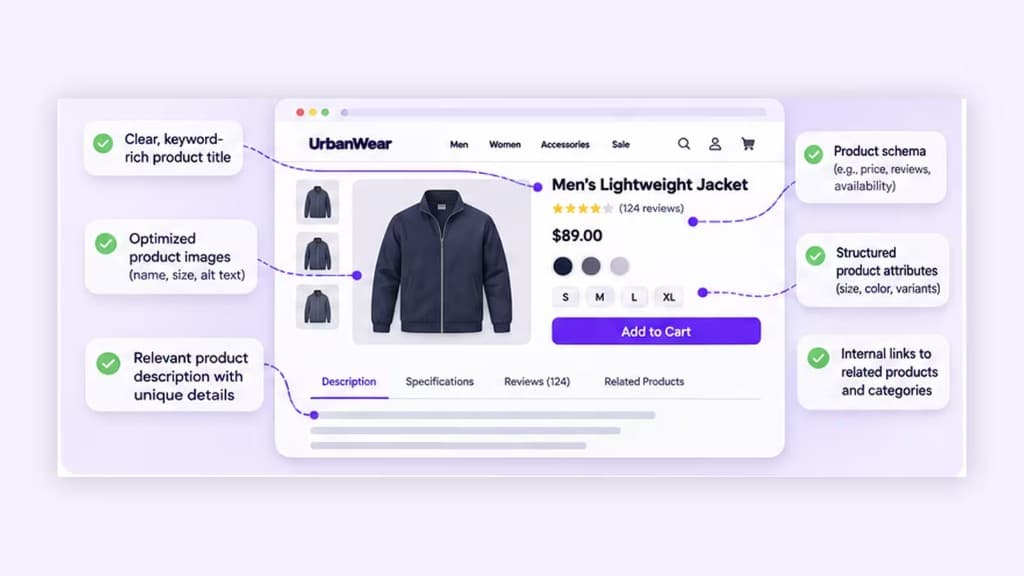
Why Ecommerce Product Pages Struggle to Rank
Common causes include blocked crawl paths, soft 404s, duplicate URLs for colour and sort parameters, thin manufacturer copy, weak internal links and search intent mismatch against category or marketplace competitors.
Check Whether Google Can Crawl and Index Your Products
- Confirm important product URLs are linked from crawlable categories or sitemaps.
- Review robots rules and parameter handling in Search Console.
- Fix soft 404s that return 200 with “unavailable” templates.
- Check canonical tags point to the URL you want indexed.
Improve Product Titles and Descriptions
Name the product the way buyers search: product type, distinguishing attributes and brand where useful. The H1, title element and opening copy should agree. Avoid SKU-only titles.
Handle Duplicate and Variant Product URLs
Colour, size and sort parameters often create near-duplicate URLs. Choose a primary URL strategy, set canonicals consistently and avoid indexing every filtered combination unless it is a real landing page with unique demand.
Implement Relevant Product Structured Data
Product structured data (for example schema.org Product with offer details) helps search engines understand name, price, availability and identifiers when the on-page content matches. Follow current Google Merchant / Search documentation for eligibility and required properties. Invalid or mismatched markup can be ignored or trigger issues in Search Console.
Improve Internal Links and Category Navigation
Products need paths from category pages, merchandising modules and a small set of related products with readable anchors. Orphan products rarely earn stable visibility.
Optimize Product Images and Page Experience
- Descriptive filenames and alt text that name the product.
- Compressed media that still looks sharp on mobile.
- Stable layout for price, variants and add-to-cart.
- Readable copy above endless widget clutter.
Check Search Intent and Competing Product Pages
Some queries want comparison pages or category grids, not a single SKU. If competitors ranking are marketplaces or buying guides, a lone thin product page may be the wrong format. Match the page type to the intent before blaming “a missing keyword.”
Ecommerce Product SEO Checklist
- Crawlable category path and XML sitemap entries for key products.
- Canonical strategy for variants and parameters.
- Unique title, H1 and description where products differ.
- Valid product structured data aligned to visible content.
- Internal links from categories and related products.
- Image compression and descriptive alt text.
- No soft 404 or thin boilerplate templates on money pages.
How to Measure Results
Track index coverage for product templates, organic clicks and conversions for priority SKUs, and Search Console queries that show impressions without clicks. Separate technical recovery from ranking competition.
Common Mistakes
- Rewriting copy while products remain blocked or duplicated.
- Indexing every facet URL.
- Copying manufacturer text across the catalogue.
- Expecting schema alone to outrank stronger competitors.
- Ignoring mobile product experience.
Final Takeaways
Make products discoverable, understandable and uniquely described — then improve authority and merchandising over time. For implementation support, see Ecommerce SEO, Technical SEO and Product optimization.
Frequently Asked Questions
Will schema markup make products rank #1?
No. Relevant product structured data can help search engines understand offers and may enable richer display features when eligible. It does not override competition, crawl problems or weak content.
Should every variant have its own indexable URL?
Only when the variant is a meaningfully distinct search destination. Otherwise consolidate with clear canonicals and selectable options on one primary URL.
How long until fixes show?
Crawl and index changes can appear faster than ranking movement. Ranking depends on competition, demand and overall site quality. Measure index coverage and enquiry outcomes, not vanity positions alone.
Do I need new content for every SKU?
Prioritize unique copy where products differ in use, materials or audience. Identical boilerplate across hundreds of SKUs rarely helps.
Ready to talk this through?
Discuss whether this approach fits your systems, permissions and team capacity.
Get Help with Ecommerce SEO